Greek Hold'em History: From Memphis Card Rooms to Omaha
 Step into the DojoFree poker against bots that learn. Earn your belt. Dojo Coin is play money.JOIN NOW
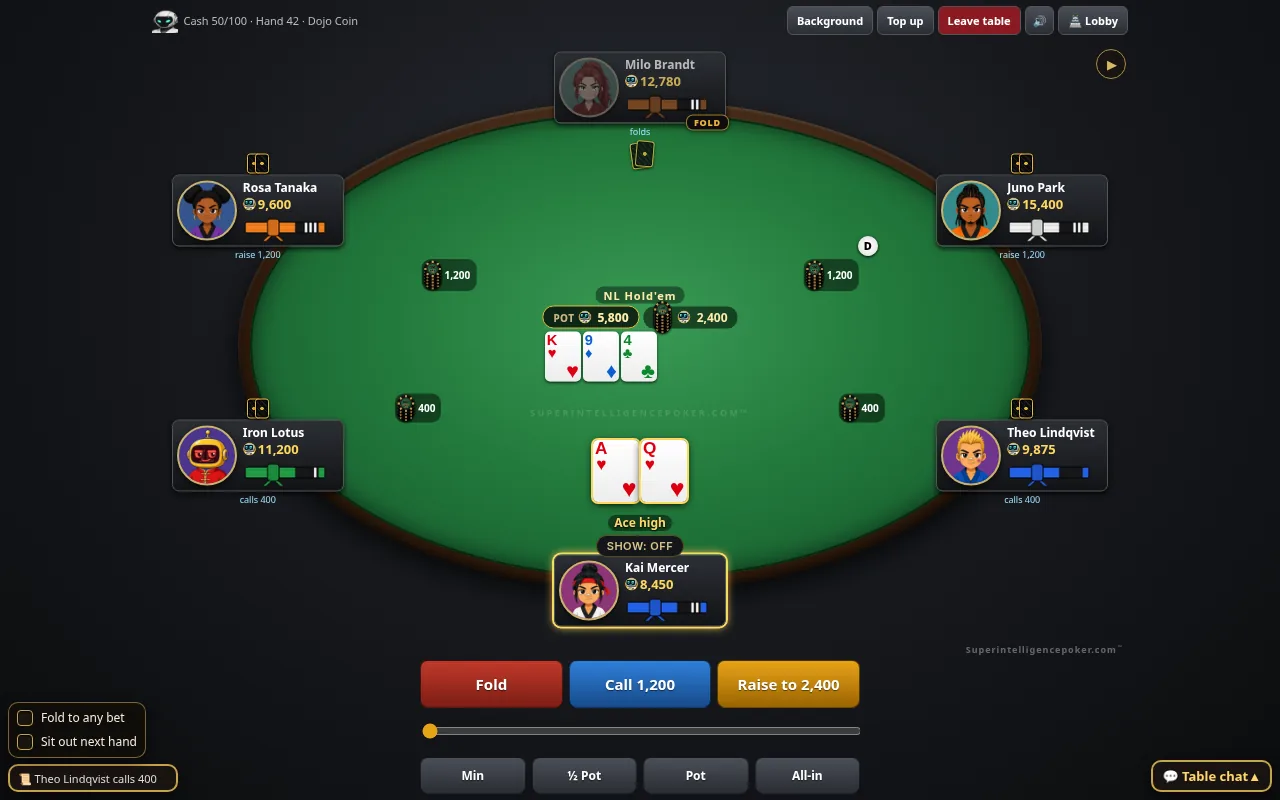
Quick answer: Greek Hold'em (also called Tight Hold'em) is a Texas Hold'em variant where every player must use exactly two hole cards and exactly three board cards. No source documents who invented it or exactly when. The earliest documented account is poker pioneer Robert Turner's recollection that it was played at a Greek club in Memphis in the 1960s. It is widely described as a transitional game between Texas Hold'em and Omaha.
What Is Greek Hold'em?
Greek Hold'em is dealt and bet just like Texas Hold'em. Each player gets two face-down hole cards, and five community cards are dealt in the usual stages: the flop (three cards), the turn (one card) and the river (one card), with a betting round before the flop and after each street. The official BARGE rulebook lists this same dealing procedure (BARGE uses limit betting).
The difference comes at showdown. In Texas Hold'em you make the best five-card hand from any combination of your two hole cards and the five board cards, and you can even "play the board." In Greek Hold'em, your hand must be both of your hole cards plus exactly three of the five community cards. That is the same "two plus three" rule as Omaha, but because you only hold two cards, you never get to choose which ones to use.
Who Invented Greek Hold'em, and When?
The honest answer is that nobody knows for sure. We could not find any reputable source that names a creator, gives a creation date or explains where the name "Greek" comes from.
Here is what is documented:
- 1960s, Memphis. In a column for GamingToday, Robert Turner, the player and casino host widely credited with bringing Omaha to Las Vegas, wrote that "in the South during the sixties we played some crazy games like Greek Hold'em at the Greek club in Memphis and Spit in the Ocean, both early versions of today's Omaha." This is a personal recollection, not a record of when the game was invented. The game may be older.
- "Tight Hold'em." According to Wikipedia and OfficialPokerRules.com, Doyle Brunson's book Super/System describes the game under the name tight hold'em. (We have not checked the book's page directly.)
- The road to Omaha. Turner says he worked for Golden Nugget manager Bill Boyd from 1977 or 1978. In 1982, during the World Series of Poker, he and a friend started a four-card game at the Nugget in which players used two cards from their hand. Boyd later promoted it as "Nugget Hold'em." Wikipedia summarizes this as Turner introducing Greek Hold'em to Boyd and the two moving to four hole cards. Turner's own column describes the four-card game rather than Greek Hold'em at the Nugget, so treat that link as a reported story, not settled history.
Turner's first-hand account also includes a joke origin story about players "holding out" cards. He admits himself that "that's not quite the truth."
Greek Hold'em vs. Texas Hold'em: Key Differences
| | Texas Hold'em | Greek Hold'em |
|---|---|---|
| Hole cards | 2 | 2 |
| Board cards | 5 (flop, turn, river) | 5 (flop, turn, river) |
| Hand rule | Any 5 of 7 cards | Both hole cards + exactly 3 board cards |
| Play the board? | Yes | Never |
| Flush with 4 suited board cards + 1 in hand | Yes | No: you need 2 of the suit in hand and 3 on board |
What this means in practice:
- Board-made hands don't help you on their own. A straight or flush on the board is worth nothing unless your two hole cards fit with three of those cards.
- Kickers work differently. Both hole cards always play, so your second card matters in every hand.
- Pocket pairs are vulnerable. With pocket aces you always have a pair of aces plus three board cards. A paired board can't help you make two pair the way it can in Texas Hold'em.
The sensei is waitingTrain against superintelligent bots. Free account, play money only. Dojo Coin is play money.JOIN NOW
For the full breakdown on starting hands and betting, read our Greek Hold'em strategy guide.
Why Greek Hold'em Matters in Poker History
The BARGE rulebook calls Greek Hold'em "a historical transition between Hold'em and Omaha." It kept Hold'em's two-card deal but added the strict must-use-two rule that later defined Omaha. Once players had four hole cards, which created far more action, Omaha took off and Greek Hold'em became a niche game. If you like the two-plus-three rule, you can compare it with its descendants in our PLO strategy guide and our Texas Hold'em strategy guide.
Play No-Limit Greek Hold'em on Superintelligence Poker
Greek Hold'em is hard to find online: none of the major poker rooms we checked lists it in its game lineup. Superintelligence Poker is one of the few places to play it. Here, Greek Hold'em is played No-Limit on 6-max tables, so every decision counts and the game moves fast. Games are played with Dojo Coin, a play currency with no cash value, so you can learn the rules without risking money. Play NL Greek Hold'em free, or play vs poker bots to practice the two-plus-three rule until it becomes second nature.
Greek Hold'em FAQ
Who invented Greek Hold'em?
No reliable source names a creator. The earliest documented account places it at a Greek club in Memphis in the 1960s.
Why is it called Greek Hold'em?
The name isn't explained in any source we found. Robert Turner's account links the game to "the Greek club in Memphis," but that doesn't prove where the name came from.
Do you have to use both hole cards in Greek Hold'em?
Yes. Every hand is exactly two hole cards plus exactly three community cards, and you can never play the board.
Is the full board dealt before players use their cards?
The board is dealt in stages as in Texas Hold'em (flop, turn, river), with betting after each. The two-plus-three rule only matters at showdown.
How is Greek Hold'em related to Omaha?
It is considered a stage between Texas Hold'em and Omaha. Omaha keeps the must-use-two rule but deals four hole cards.
Sources
1. Robert Turner, "The origins of Omaha Hi/Lo poker," GamingToday: https://www.gamingtoday.com/news/the-origins-of-omaha-hi-lo-poker/
2. BARGE Rulebook, "Greek Hold'em": https://www.barge.org/rulebook/greek-holdem.html
3. OfficialPokerRules.com, "Greek Hold'em Rules": https://officialpokerrules.com/greek-holdem/
4. Wikipedia, "Greek hold 'em" (starting point only): https://en.wikipedia.org/wiki/Greek_hold_%27em
5. Doyle Brunson, Super/System (cited via sources 3 and 4 for the name "tight hold'em")
Ready to take a seat?Join free and put what you just read to work at the tables. Dojo Coin is play money.JOIN NOW