Texas Hold'em Strategy: How to Win More at 6-Max Tables
 Step into the DojoFree poker against bots that learn. Earn your belt. Dojo Coin is play money.JOIN NOW
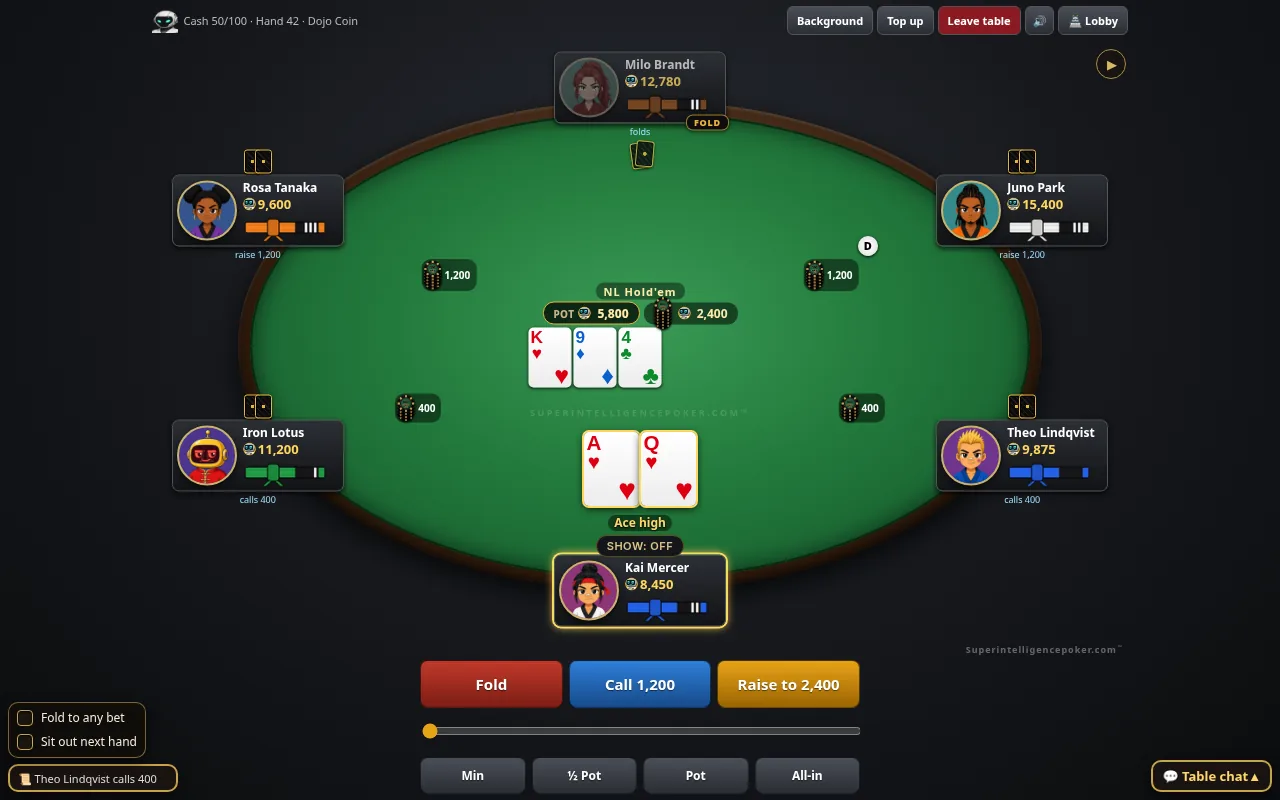
Quick answer: Good 6-max Texas Hold'em strategy comes down to five habits. Play more hands from late position and fewer from early position. Open with a raise instead of limping. Keep betting the flop when the board favors your range. Fold when a passive player suddenly raises big. And size your bankroll so normal swings don't knock you out. Every table at Superintelligence Poker is 6-max, so these tips are tuned for six-handed play.
New to the game? Read the Texas Hold'em rules first, then come back. We'll wait. (The bots won't. They never sleep.)
Texas Hold'em strategy: 6-max table at Superintelligence Poker. Image: Superintelligence Poker.
Why 6-Max Hold'em Plays Differently
With only six seats, the blinds come around fast, so you have to play plenty of hands to keep up. Ranges get wider, hands like A-8 offsuit or K-T become real raising hands from the later seats, and you'll play far more pots heads-up. The players who win at 6-max are the ones who stay aggressive without spewing chips.
Starting Hands by Position
Position is the biggest edge in Hold'em. Acting last lets you see what everyone does before you decide. Here's a solid starting framework for opening (raising first in) at a 6-max table:
- Lojack (first to act, about 17-20% of hands): pairs 22+, A-2 suited and up, A-T offsuit and up, K-T suited and up, K-J offsuit and up, Q-T suited and up, J-T suited, T-9 suited, 9-8 suited.
- Hijack (about 21-24%): add A-9 offsuit, K-9 suited, Q-J offsuit, J-9 suited, 8-7 suited.
- Cutoff (about 27-30%): add A-8 offsuit and down to A-5 offsuit, K-T offsuit, Q-9 suited, suited connectors down to 6-5.
- Button (about 40-50%): add most suited kings, many suited queens, offsuit broadways, and suited one-gappers.
- Small blind: raise or fold is simplest. Play roughly as wide as the cutoff.
These are starting points, not laws. Against tight blinds, open wider; against players who 3-bet a lot, tighten up.
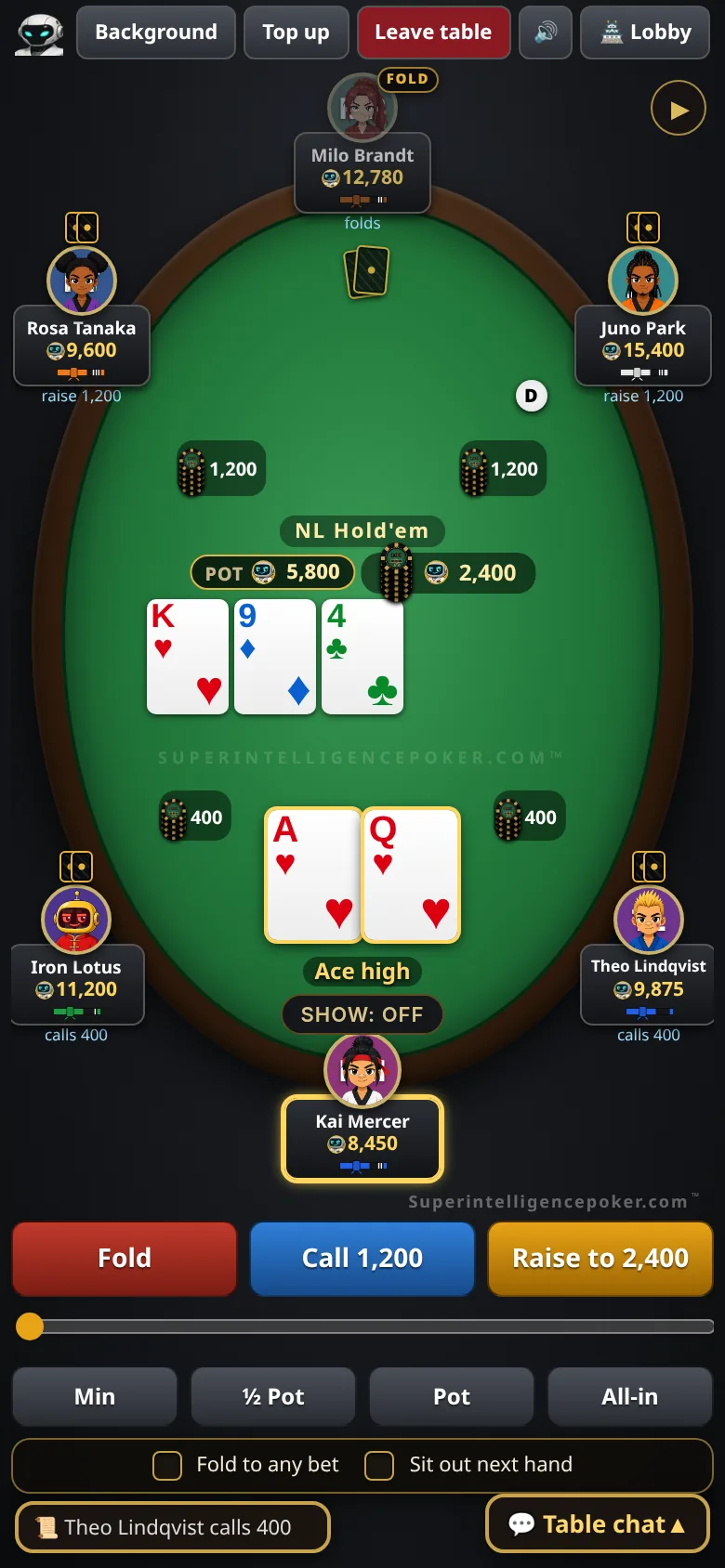
Texas Hold'em on a 6-max table, phone view. Image: Superintelligence Poker.
Pre-Flop Play: Raise, Don't Limp
The most common leak at free tables is limping (just calling the big blind). Limping lets the blinds see cheap flops and hands you no way to win the pot right away. Instead:
- Open-raise to about 2.5x the big blind from most seats, a bit bigger from the small blind.
- 3-bet (re-raise) to about 3x the open in position, 3.5-4x out of position. Use a mix of strong hands (QQ+, AK) and a few bluffs with blockers like A-5 suited.
- Defend your big blind wider than you think. You're getting a discount, so call with many suited hands and connected cards against late-position opens.
- Respect 4-bets from tight players. Their range is usually QQ+ and AK.
Post-Flop Strategy
Continuation betting
If you raised before the flop, you usually have the "range advantage" on high-card boards like A-K-4 or K-8-3. Bet small (about one third of the pot) often on these. On low, connected boards like 7-6-5 that hit the caller's range, check more and bet less.
Think in ranges, not single hands
Don't put your opponent on one exact hand. Ask, "What hands would they play this way?" Then count how often you're ahead. This is the habit that turns break-even players into winners.
Pot control and value
With a medium-strength hand, like top pair with a weak kicker, keep the pot small. With a strong hand, bet for value on all three streets when worse hands can call. Most players at free tables don't bet their big hands enough.
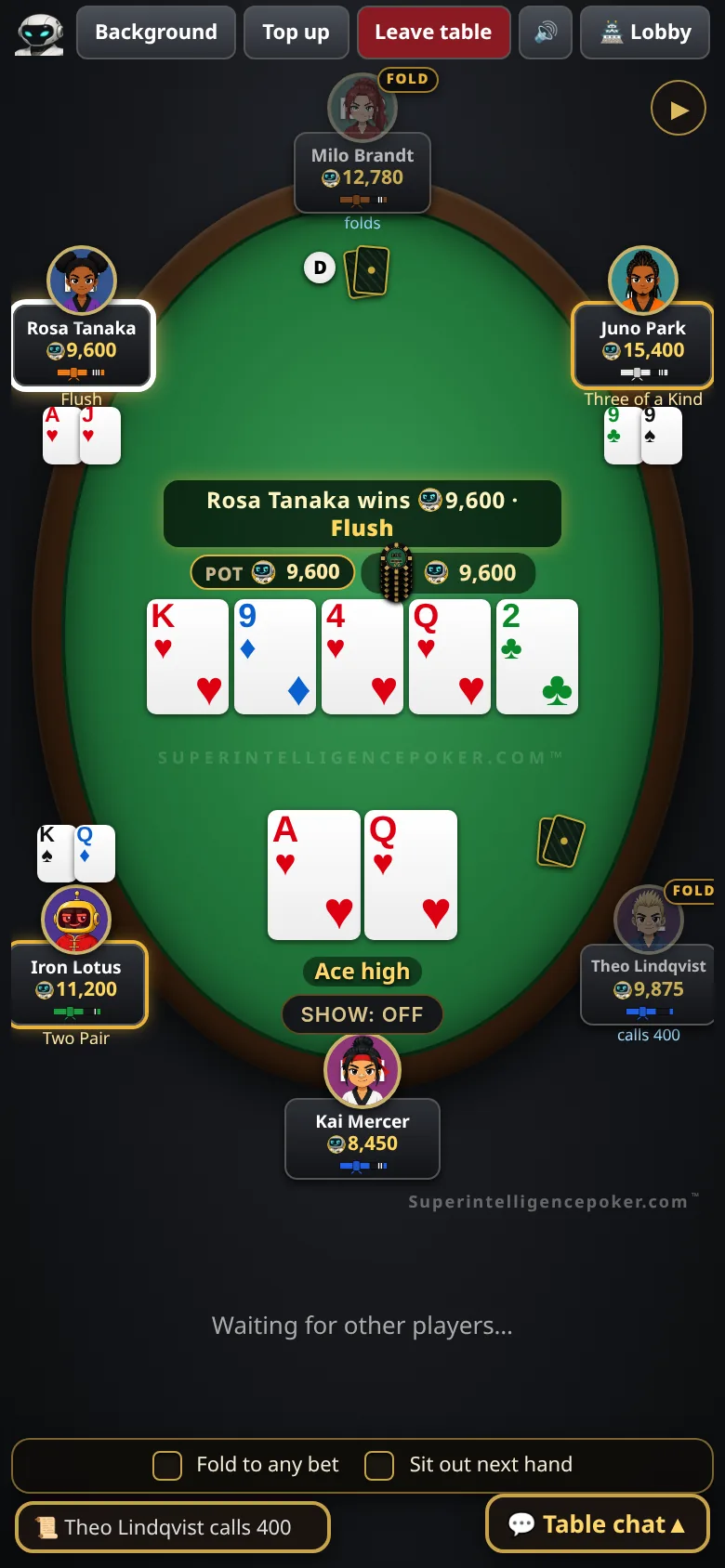
6-max Texas Hold'em showdown at Superintelligence Poker. Image: Superintelligence Poker.
Bluff with a plan
The best bluffs have backup: flush draws, open-ended straight draws, or overcards. Semi-bluffing gives you two ways to win, and it's how the bots in the dojo build pressure.
When you're ready to test this, play online poker for free against humans, trained bots, or a mix.
Common Hold'em Mistakes
The sensei is waitingTrain against superintelligent bots. Free account, play money only. Dojo Coin is play money.JOIN NOW
1. Playing too many hands out of position. K-J offsuit under the gun is a trap at 6-max.
2. Calling too much, raising too little. Passive play loses chips slowly.
3. Overvaluing one pair. On wet boards, top pair can be in bad shape when a tight player puts in big raises.
4. Bluffing the calling stations. Some players never fold. Value bet them instead.
5. Ignoring stack sizes. With 20 big blinds or less in tournaments, push-or-fold play beats fancy post-flop moves.
6. Tilt. One bad beat turns into ten bad calls. Take a break.
Bankroll and Variance
Even perfect Hold'em has big swings. A strong player can lose for thousands of hands in a row thanks to bad luck. Good habits:
- Keep at least 30-40 buy-ins for the cash level you play, and 50-100 buy-ins for tournaments, since their swings are larger.
- Move down when you drop below that, and don't chase losses.
- Track results over thousands of hands, not one session.
At Superintelligence Poker, every game uses Dojo Coin, play money with no cash value. You can't buy it and you can't cash it out. That makes it a perfect place to practice bankroll discipline with zero risk. Treat your Dojo Coin stack like it matters and your habits will carry over.
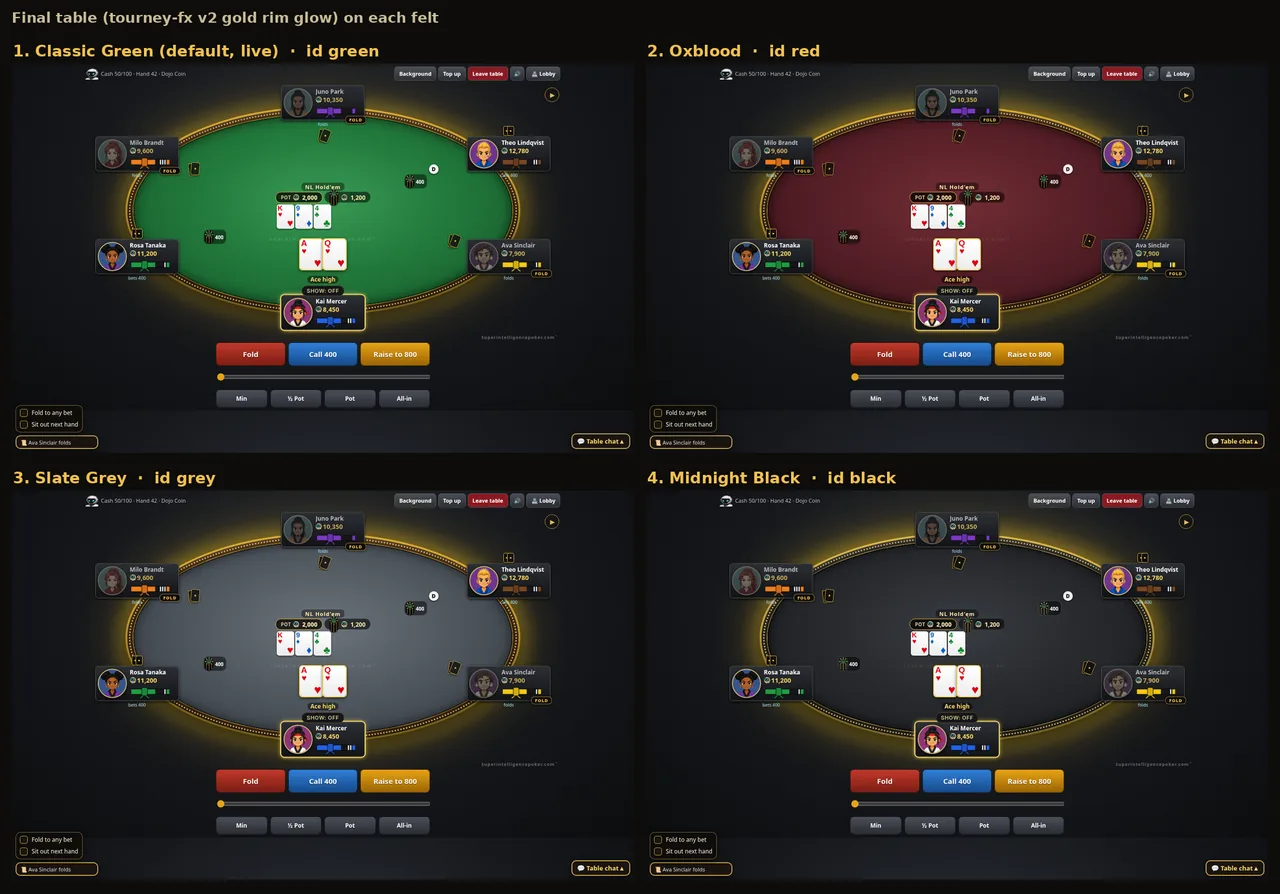
Superintelligence Poker felt colors. Image: Superintelligence Poker.
Practice Plan
1. Pick one leak a week, such as limping or under-defending the big blind.
2. Play a session focused only on fixing it.
3. Review your stats and hand history afterward.
4. Earn belt points in tournaments as you improve.
Ready? play online poker for free and see how your ranges hold up against the dojo bots.
FAQ
What is the best starting hand in Texas Hold'em?
Pocket aces (A-A). They're a big favorite against any other single hand before the flop.
How many hands should I play at a 6-max table?
Roughly 20-30% overall, from about 17% in the first seat to 40% or more on the button.
Should I ever limp in Hold'em?
Rarely. Raising first in is better in almost every spot. Completing from the small blind against a passive big blind is the main exception.
What is a continuation bet?
A bet on the flop by the player who made the last raise before the flop. It works best on boards that favor the raiser's range.
How big should my bankroll be?
A common guideline is 30-40 buy-ins for cash games and 50-100 for tournaments.
Can I practice Hold'em for free?
Yes. Superintelligence Poker uses Dojo Coin, play money with no cash value, so every game is free practice.
Related Strategy Articles
Sources
- Upswing Poker, "Preflop Ranges / 6-Max Opening Ranges": upswingpoker.com
- PokerNews, "Texas Hold'em Strategy" guides: pokernews.com
- David Sklansky, The Theory of Poker (Two Plus Two Publishing)
- Wikipedia, "Texas hold 'em": en.wikipedia.org
- Superintelligence Poker, Texas Hold'em rules
Want to go deeper? play online poker for free and put these ideas to work.
Ready to take a seat?Join free and put what you just read to work at the tables. Dojo Coin is play money.JOIN NOW